Dark Side of the Moon


Of all the albums that entered our world in the year of ‘73, this is by far the most popular. Of all the discs in the entire history of recorded music, only one has sold more copies worldwide. There should be obvious reasons for such amazing success. But explanations - obvious or oblique - break down in this case.

Charisma? Hardly. Pink Floyd in ‘73 was the paragon of cold-blooded corporate rock - faceless, arrogant and isolated from the world. Devoid of stage presence or interesting life stories, the band consisted of four ordinary-looking men with boring names and no discernible talents that would set them apart from 10,000 other musicians. Virtuosic playing? Originality? Sex appeal? The visceral throb that gets people up and moving their bodies? Pink Floyd had none of these. Early on, when Syd Barrett was their front man, they were charmingly acid-addled, whimseyed and weird. Their “Interstellar Overdrive” sent their fans out through the gleaming stars. After Syd was gone, the band kept some of its cosmic sublime, but headed into more doom-laden terrain, “Set the Controls for the Heart of the Sun” being a perfect soundtrack for glorious teenage solar suicide. By ‘73, with Dark Side of the Moon and the hugely profitable tours around it, Pink Floyd had lumbered to the top of the dinosaur food chain, the reigning tyrant lizards of arena-rock. With upwards of 40 million units sold, with literally billions of plays, this music - like no other - flooded the earth with its message, the gospel of self-annihilation that the moon’s hidden side represents.

Golgotha is not just a place in the little Holy Land of the Middle East. The real Golgotha - “the place of the skull” - is in outer space, a quarter million miles away, orbiting around the earth. The moon is our primal, eternal skull-icon. And all of our skulls are tiny versions of the great skull in the sky. What do we see in the moon’s leering face? Eye holes, gaping toothless mouth, nostril slits, the empty stare of the Great Death’s-Head. Calvary is not just a place of ancient torture and obscure sacrifice. Calvary - “the place of the skull” - is out there, night after night. The moon is the universal face of death and also the earth’s primary mirror - shining back the light of the sun, the source of all life. So when this Face of Death stares raptly into itself, of course there is an invisible side of the reflection: the dark side, untouchable, unknowable, real and yet absolutely unseen.

As music, Dark Side of the Moon is a grand mediocrity. With its bloated blues imitations, fake soulful moaning, banal synthesizer squiggles, its utter absence of original melodies, lyrics, or musical hooks, this album should have disappeared into the great cut-out bin of LP oblivion. Instead, it sold in vast numbers and kept selling, spending a total of fifteen years in the charts. Ultimately, it colonized more brains than all of the albums released in ‘73 combined.

The secret of this record’s success is in fact no secret at all. It’s all right there in the title and the last line of the song “Brain Damage.” To the sullen, smug teenagers of the world (young and old) Roger Waters sings “I’ll see you on the dark side of the moon.” His lyrics mention racing “to an early grave,” exploding heads and brutal psycho-surgery. There may be many far better examples of I-want-to-die music. Originality, however, doesn’t sell. Complexity and intelligence don’t make for commercial world domination. The very banality of Dark Side of the Moon works in its favor. If a band is going to create a mass market hymn to self-obliteration, then subtlety is not going to be one of their tools. If Pink Floyd set out to make enormous profits, then playing directly to their audience’s inner deadness was exactly the right technique. Making self-pity into grandeur, numbness into stoned mysticism, stupidity into exaltation, Dark Side of the Moon is the perfect product. Heartless, pompous, blotting out everything like brain-death or an eclipse, whining and empty, this is the sound of cretinous nihilism, the wretched little self screaming “me! me! me!” in a vacuum.


On their previous - unnamed and unnamable - album, Led Zeppelin used four symbols to represent the four members of the band. The symbols all give the impression of secret truth hidden in plain sight. The first, Jimmy Page’s, sign is sometimes read as the magical nonsense word “Zoso.” For many fans this is the name of the fourth album. But the actual glyph itself is far more complex than a childish four letter word. It’s composed of four fused elements: a sleek and slithery Z with a curving tail, an elongated S that might also be a lost musical clef, two O’s with dots in the middle connected by a slender bar, and at the bottom a calligraphic scribble-slash that might be a pot-pipe or perhaps Aladdin’s lamp. All together, they form a sigil of power and bafflement. Nonsense perhaps, a magickal hippie doodle, or an arcana-scrawled doorway waiting to be opened.

Scholars, fan-boys, paranoid religiasts and esoteronauts have assigned a wide array of meanings to the glyph. Does it make reference to some Crowleyite spell? Is it an oblique Nietzschean strategy, the name “Zoroaster” compressed? Or split into the near-palindromes “Zoso” and “Rater”? Does this refer to Zoser, the Egyptian pyramid, or to herpes zoster, the viral pestilence? Benighted christians have seen “666” (the Mark of the Beast) in the emblem. We see the astrological sign for Saturn, the ringed planet, and the alchemical symbol for lead.

This emblem, well beyond the other three, had a life of its own, appearing on Jimmy Page’s amp, his shimmering cape, his silky wizard pants. But none of the symbols were to be seen on the fifth album. In effect, they had done their job - transforming themselves, from symbol to actual ritual. Houses of the Holy, Led Zeppelin’s next album, contains that ancient rite.

The cover shows the Giant’s Causeway: 37,000 hexagonal basalt columns on the north coast of Ireland. Some are complete, others broken. Some have sharp edges, like huge rusted nuts made to screw onto bolts. Others are like six-sided, lichen-crusted prehistorical wheels tipped on their sides. All of them fit together not as a puzzle but a temple built before mankind had ever come to that place. Dawn, or some baleful astral being, glows at the peak of the stones - sickly orange, crimson, seething yellow.

Opening the gatefold cover reveals a scene of pagan ritual. Is it sacrifice or exaltation? Eleven naked elf-children crawling over the stones, ascending - pale and ghostly - to meet their sunrise god. White-blond hair, powder-white skin. Not pasty subterranean pallor but soft forms dusty with sky-pollen.

They’re faceless, seen from behind. Six years old, maybe eight. Natural forms, not pure but prepubescent, like something Lewis Carroll would hallucinate on laudanum. Some claim they are all the same child, the body reproduced eleven times. But clearly some are boys and some are girls. Others say they are brother and sister, like a childish Siegmund and Sieglinde in The Valkyrie.

One lies on her belly like a mermaid. One squats. Another holds her hands above her head, in awe, expectation, opening herself to the solar crest-glow, making the same Y-shaped salute to the sun that the wandervogel and yogis used to greet and worship their god.

Inside the fold-out cover, a more overtly sacrificial image is revealed. It’s now sunset and a naked man holds a naked child above his head - clearly an offering - before the fungous nightmare ruins of Dunluce Castle. Rotted stumps of stone, a ravine crossed by a decrepit bridge, two towers, all decayed, all bathed in the same arcane radiation: oozy pink and orangey-green. Rich blue in the upper sky. It could be the surface of another planet, earth a million years in the future or the past.

It’s dusk now. The pale children are gone except the chosen one, the sacrificial offering. From the top of the citadel a faint white light gleams. And a milky beam extends downward to consume the naked priest and his offering.

New York Dolls


They’re the missing link, the evolutionary lost boys. Not a fossil or a dried-up dinosaur turd but a living, panting, gibbering pack of big city anthropoids, the New York Dolls carried the fool’s gold genes of glam rock and passed them on to the monkey horde of punks who followed close behind.

Glam rock, at first and second glance, was about nothing more than absurd clothes, gobs of makeup and alien aliases. Suburban kids dressed up as outer space drag queens, with feather boas, platform shoes and skintight silver pants. Scrawny white guys with boring names turned themselves into Ziggy Stardust, Eno, Gary Glitter, Jobriath, Johnny Thunders and Sylvain Sylvain. Glam is show-biz, and often is shrugged off as a fleeting shock wave from the gay-lib explosion, androgynous and pan-sexual youth gone wild on stage. And there’s no question that straight boys dressed as transsexual hookers are pushing (or at least slouching against) the walls of sexual order. There’s also the druggy halo to consider: heroin, cocaine, and speed were part of the seedy street-chic.

Still, there’s an unspoken, largely unseen element that looms here: something faintly gleaming in the corners of the mind like albino radiation sickness or nacreous moonglow. Glamor, we never forget, is in the oldest sense of the word about bewitchment. “Glamor” meant a magic spell or charm.

David Bowie sang about the “homo superior” in 1971 and about “making the wild mutation” a year later. Deodato put Nietzsche’s Uebermensch into heavy radio rotation. This isn’t progress we’re talking about, but transformation. This isn’t high tech shiny-future optimism, but real teratism - monster making. Mutants usually are highly unadaptive, often flat-out harmful to species survival. The New York Dolls got lost in the gene-jungle, pop culture natural selection making sure there were no direct offspring, no Darwinian success. They were five skinny white boys who mutated into nightmare Ken dolls - five versions of Barbie’s sexless mate dressed up as man-sluts and singing about their “Personality Crisis.” These Kabuki Kens, however, have real bulges in their pants. They’re anatomically correct and when the drugs allow, they’re ready to rut and shoot some bad seed.

Still, they’re both menacing and absurd, with their teased-up hair, gleaming lipstick, scarves, blotches of rouge and pubescent pouts. They never lost their confusion. Were they bad boys or sleazy fashion victims, sexual predators or kids playing dress-up? Later, they’d plumb the depths with too much junkie business, crashed careers, early death and the bass player converting to Mormonism. Always, though, they maintained their unapologetic stance: rude, crude, loud and wild.

There’s a “Lonely Planet Boy” and a “Jet Boy” on this album. Mostly, though, they stay in the street, bumping and grinding through “Bad Girl,” “Pills,” and “Trash.” Two largely overlooked songs point to something far more disturbing that drug-punk bad-assitude. Both are about tainted birth, the genesis of the Baleful Other. They’re not just sex songs, but confused, obsessive leaps into the pit of bio-reproduction.

After “me,” the word “baby” is probably the most common in rock and roll lyrics. In “Vietnamese Baby,” however, the Dolls are talking about about real conception and newborn spawn, the bastard offspring of a U.S. soldier and a nameless, faceless girl on the far side of the globe. The song starts and ends with a cliché Asian gong. In between there’s the standard proto-punk riffs and railing. As music, it’s okay. As a shout of confused dread (“talking ‘bout your overkill!”) it’s definitely not okay. We never know who’s the “you” of the song or why she’s got a Vietnamese baby on her “pretty little mind.” But we do understand that something is very wrong and it’s not going away.

The third Frankenstein song of ‘73 (labeled “original” on the album cover) was the last one of the year. Again we’re in movie-monster land - “shoes too big, jacket too tight.” And again Frankenstein stands for something ill-defined and intolerable. The song starts with an image of war, or biological disaster. “Something must’ve happened over Manhattan.” It quickly gets more personal, a repetitive, far-too-long track built mostly on unanswered questions. “Who could’ve spawned all the children this time?” We never find out. “Do you think you could make it with Frankenstein?” Is this about sex with a monster or is “make” here about literally making a baby, the nameless “it”?

1973 was the year of the American abortion. In January, Roe v. Wade transformed the country’s relationship with its unwanted offspring. Frankenstein’s creature calls himself an “abortion” and here on the Dolls’ first album he returns again: the divine portent of misfortune, the monster-spawn who may be loved, but who must be destroyed.


At the height of American technological triumph, Elvis released this throwback tune, his hymn of praise to 19th century low-tech machinery. He’s no Saturn rocket or lunar module. He’s not even a diesel-driven bulldozer or an 18 wheel Mack truck, but a steamroller, and this is his version of heavy metal.

The picture sleeve from the single makes it even more obvious - this machine (in sepia tone) comes clanking out of the past, with gears, chain-drive and a smokestack like you’d see on a ironclad from the Civil War. Everything about the steamroller here is archaic, weighty and slow. Yet Elvis sings with a surprising amount of swagger. “I’m a steamroller!” and, he declares, he’s going to “roll over you.” The music too - even with the Vegas big band screaming trumpets - is a throwback. The classic Elmore James “Dust My Broom” riff holds the tune together and gives it old fashioned dirty blues energy. There are no references to the moon here. This is Earth-Elvis, the low-tech destroyer Elvis.

It’s all built on a series of ego-declarations. He’s a steamroller, then a cement mixer, a “churnin’ urn of burnin’ funk.” This line harks us back to the previous year’s Big E hit: “Burnin’ Love.” Mostly that tune is built on standard love-is-fever images: rhyming “fire” with “higher and higher” and “the sweet song of a choir.” But with its obsessive chanting chorus (“hunka hunka burnin’ love”) and Elvis’s frantic “my brain is flaming!” it seems to conjure up a victim of spontaneous cerebral combustion.

“Steamroller Blues” moves on to stranger comparisons. Elvis is a “demolition derby,” not one car but the whole gear-grinding white trash apocalypse, leaving him a “hefty hunk of steaming junk.” And then he’s a “napalm bomb, baby.” After ten years of the war in Vietnam, there was hardly a word less tainted than “napalm.” For most Americans, even those who supported the war, it meant uncontrolled fiery death from the skies. And here’s Elvis saying he’s napalm and will “blow your mind.” The minds of his fans were already blown, though seldom did they think of their idol dropping jellied gasoline onto them from a helicopter gunship.

Elvis’s brain, “flaming” or otherwise, is not the frequent subject of in-depth analysis. He was, though, a man given to much thought, especially on such topics as astrology, UFOs, pyramids and reincarnation. Likewise, he was much given to reading. Wherever he traveled, Elvis always had his servants bring along his personal library of over two hundred spiritual books, which included various Bibles, the Dead Sea Scrolls, and Kahlil Gibran’s The Prophet. He took his occult researches all the way to the end: dying on the toilet reading The Search for the Face of Jesus, a book about the Shroud of Turin.

In short, when he wasn’t thinking about burnt bacon, peanut butter, and “Takin’ Care of Business,” his mind went to the occult. Even his conception had a mystic quality. Vernon Presley told his son that he’d known the exact instant when he’d come into being because at that moment, Vernon had lost consciousness. Though there is a more common explanation for such an event, Elvis took this orgasmic blackout as an absolute sign that at the moment of conception his father had become possessed by a higher power, God himself. Thus exalted, Elvis embraced the notion that Vernon - ex-con and paint factory worker - was not his true “daddy.” On the night Elvis was born, Vernon walked into the backyard and saw the heavens suffused with a divine blue light. Elvis took this story too as part of his mythos, as he’d long associated the color blue with his own supernatural power, and with his fate as the “One.”

The “One” or the “All?” This is the question that truly matters. A singularity or infinity itself? A cryptic emblem featured on his stage costume points toward our answer. Elvis’s jumpsuits came from the moon, but they were adorned with far more arcane emblems than NASA might provide. Elvis had massive belts, reminiscent of those worn by pro wrestlers and boxing champions. The buckles featured Elvis’s most cherished icons of power. One of them became more noticeable and important in his last days on Earth. It was a wide rectangle, outlined in silver and set with 26 rubies. Inside the border were 16 turquoise studs and at the center were two ovals just touching at the tips. UFO fanatics have compared these ovals to two alien eyes or two flying saucers docking. There’s a far more obvious interpretation. This symbol is the lemniscate, the figure 8 lying on its side, the mathematical sign of infinity. And if anyone was going to reach the infinite in ‘73, it would be Der Elvis.


In raw schlock, pure truth is sometimes hidden. In cheap, cheesy, bottom-feeder pop fodder, secret knowledge can be found, if listeners tune their ears to the right frequencies and adjust their inner dials. Where better to conceal astral wisdom than blasting from countless radios? When Deodato’s “Also Sprach Zarathustra (2001)” hit the air waves, millions knew with their bodies what their minds would never comprehend: after the Apollo-men had been to the moon nothing would ever be the same.

Americans had made their lunar odysseys and were now - in early ‘73 - back for good. It took a Brazilian jazz pianist sleazing his way through a German’s orchestral masterpiece based on an exile-German’s most famous philosophical tract to get the message out. First, however, came the British film, 2001, a Space Odyssey. Deodato’s proto-disco version of Strauss’s tone poem would never have happened if it hadn’t been used as the film’s main fanfare theme, its clarion call to new consciousness. In 2001, it’s orchestral - a straight rendering by the denazified conductors Boehm and Von Karajan. In the top 40 hit, it’s lounge-jazz afro-caribbean funk. Starting with a sub-bass groan, Deodato adds jungle-creature noises, conga drums and shakers, electric piano and chunka-chunka pulse bottom. A swankering guitar solo comes forward, and then the grandiose Teutonic brass fanfare. If this global burst of groove-gnosis weren’t so crucial, it would be hilarious. From Nietzsche and Richard Strauss to Stanley Kubrick’s film. And from there to something that might serve better as the soundtrack for a TV sports special than for the human mind breaking into the translunar beyond and meeting the Unspeakable Cosmic Other.

Nietzsche proclaimed the next step in human development - not the imbecilic Aryan superman who crushes the untermenschen, but the self-overcoming, self-transcending man. A Darwinian post-monkey man looks nothing like Nietzsche’s Uebermensch. Zarathustra tells us: “what is great in man is that he is a bridge and not a goal.” A link, a span across the void, a reach into the past and future (which are the same for Nietzsche): this is what the prophet came to show us.

How much of this did Eumir Deodato understand when he entered the studio and got the Brazilian space-funk cooking? Absolutely none of it. Other orchestral pieces had been retrofitted for American radio. “Bumble Boogie” and “The Nutrocker” had made it onto the charts. In 1972, as the last men on the moon made their final lunar sacrifices, a group called Apollo 100 put “Joy” (based on “Jesu, Joy of Man’s Desiring”) into the top ten. The year before that, Walter Carlos had made science fiction synthesizer versions of Rossini and Beethoven integral to Kubrick’s Clockwork Orange. Only a few years later would come “A Fifth of Beethoven,” a disco-kitsch version of the most important symphony in the history of that form.

It took the American Idiot-Zarathustra - Der Elvis - to truly integrate Nietzsche and Strauss into pop-cosmic consciousness. Once he heard the celestial brass and booming drums, he knew that this would be the perfect sound for his grand entry onto the stage, every concert beginning with Strauss’s theme of exaltation. Elvis may not have been able to pronounce the prophet’s name, but he knew a trans-galactic power riff when he heard it. His jumpsuits too, the emblem of his power and glory, came straight from the moon. He started wearing them the year that Apollo 11 landed and he never gave them up. Weighing close to thirty pounds (with another ten for the massive belt) the jumpsuits are his version of space-wear. Pure white, stiff and cumbersome, with a high napoleonic collar, crusted with arcane symbols and strange patriotic emblems, these are the magic garments needed for his liftoff into the prophetic heavens.

What was Zarathustra’s message that everyone knew with their bodies but couldn’t bear to know with their brains? It’s actually quite simple - all crucial truth is. Something is out there, something vast and far beyond our ability to comprehend. And meeting it, human consciousness is like a fluttering candle flame obliterated in the radiance of a star going nova.

Monster Mash


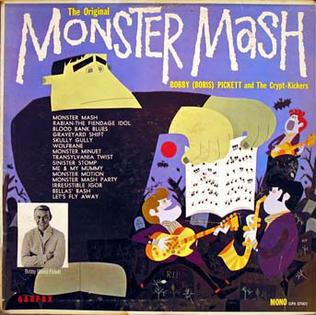
There were two more Frankenstein records that year. The first was actually a re-release, one of those rare cases of a long-dead novelty tune brought back to life. The 1962 “Monster Mash,” by Bobby Boris Pickett - for reasons never revealed - appeared again on the U.S. charts in the summer of ’73. Doing a cheesy imitation of Karloff, Pickett had jumped on the early sixties fad-wagon of Everything Monsters: two hit TV shows (The Munsters and The Addams Family), the Aurora model kits (the first of which was of course Frankenstein’s monster), lunch boxes, stickers, board games and toys. Like the James Bond spy craze and Beatlemania that followed it, the wave of new-old monsters swept over American pop culture. The fad came and went, before the first man had put his boot on the moon. Why did it then return a decade later, as the last Saturn rocket was being prepared to put the last sons of Apollo on the moon?

“Monster Mash” is musically negligible. And the lyrics are barely above the level of a seventh grader’s high concept: “Hey, what if that Frankenstein guy from the movies was the front man for a rock and roll combo?” It has the requisite references to the lab and the undertaker’s slab, ghouls coming to “get a jolt from my electrodes,” chains, graveyards, coffin-bangers and crypt-kickers. But pulling apart the strands of the backstory, we find a far more complex tangle of knots. Here’s a nonentity American singer imitating a British actor who’d changed his name to the Germanic “Karloff” and who played both the berserking monster and the mad scientist maker. The tune comes out at the height of the craze, then disappears for ten years. Clearly, someone’s electrodes were clamped onto this musical corpse. Someone’s life-giving electro-juice ran through it and brought it back to life.

“Frankenstein,” as he first appears, is not the creature but the creator. Plays, films, and knockoff novels blurred the name’s use. Eventually, it’s the monster (a term almost never used in Mary Shelley’s book) that gets the moniker. But we do not forget that the original Frankenstein is a man, not a man-made being. He’s a scientist, a seeker, a wild-eyed Romantic Germanic hero. Shelley’s subtitle - “A Modern Prometheus” - captures the essence of his story. This is now, not the ancient days, and still there are heroes willing to risk all to grasp the torch of secret knowledge. Stealing fire from heaven and bringing it back to earth, Prometheus gained himself the eternal hatred of the gods. For his crime, he was chained to a rock, with an eagle picking out his liver. Celestial fire is for the gods, not humans, and those who dare to think otherwise will be punished forever. Yes indeed, as Neil Armstrong said when Apollo 11 touched down on the moon, “the eagle has landed.”

Perhaps linking this doomy grandeur to idiotic schlock-and-roll is simply too much. But, Shelley’s creature tells us at the end of the novel, “the fallen angel becomes a malignant devil. I, the miserable and the abandoned, am an abortion, to be spurned at and kicked and trampled on.” Songs are creatures too, with a life and a death, and an afterlife. Recordings live on in the heavens, though there’s nothing much lower in the musical hierarchy than a fad-riding novelty tune. Is the “Monster Mash” an abortion, a divine portent of misfortune, a piece of Top Forty drivel or an Opener of the Way? We are convinced that it can be all of these. Listen then, to the last lines of the song: “For you, the living, this mash was meant too. When you get to my door tell them Boris sent you.”


Edgar Winter’s White Trash came slinking out of the shadows in 1971. Two years later, he rode this cold slab of rock and roll albinism to the top. The Album and the Albino, the high priest’s Alb and Albumen, the lowly white of an egg. They’re all linked, each of them descending from “Albus,” the Latin word for absolute whiteness. Albedo is a bit more complicated. For the astronomer, it’s the reflecting power of a planet or moon. For the physicist, it’s the degree to which a surface reflects back cosmic radiation.

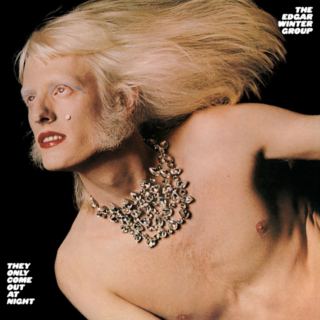
You want more? You need more? We’ve got it - all of the evidence hidden right out in the open. Album covers are magic amulets, containers of pop cult esoterica, squares of throwaway idiocy and at the same time secret maps of the starry regions. They Only Come Out At Night - how much more obvious does it need to be?

The cover features a Francesco Scavullo fashion photo of the whitest rock star on the planet. Naked, Winter poses at a strange oblique angle, as though he’s an astral messenger zooming through space/time. But of course he’s no angel, nor a devil. Winter, here, emerges as a true celestial emanation, neither male nor female, alien nor human, but the next species. His eyes gleam upward - toward the heavens? in drugged ecstasy? dreaming of himself as the next shooting star? Scavullo makes Winter look like a living comet - complete with tail of icy colorless hair streaming behind. A golden beauty mark pulses on his cheek. His lips are painted a vivid red. The only thing covering his naked skin is a multi-tiered diamond necklace. Here is, in short, maximum space-freak: milk-pale skin, midnight black background, and a slash of juicy crimson on his lips.

On the back cover he’s even more transgressively genderless, one half pink satin Barbie and one half Prince Charming. The other members of the band are nowhere near as fetchingly weird, mustering about as much menace as sebaceous sophomores dressed up for the prom. And for the most part, the music they create is banal white-boy schlock, party tunes such as “Hanging Around” and “We All Had a Real Good Time,” and that pinnacle of originality, “Rock ‘n’ Roll Boogie Woogie Blues.”

Then there’s “Frankenstein,” the monster hit off the album, the only cut that matters. Supposedly the track got its name because it was cobbled together out of various unrelated parts. We'll never know if this is true - the scars and seams and stitch-marks aren’t obvious. To these ears, it’s not a hodgepodge of mismatched limbs and organs, but the zap-spark sound of the mad scientist’s lab. Winter’s synthesizer dominates the mix, though there’s less bleeping here and far more squiggle-riff voltaic surges than on other synth-heavy tunes of the time.

In a way, it’s just another blues instrumental, complete with drum solo and sax break. But updated and juiced with the high tech of the day, it’s the aural equivalent of the comet Winter portrays on the cover. At one point he even gives us a perfect buzzy musical sketch of a space craft landing on the moon. Glimmer, glam, glitz - all of these of course are about reflection, not absorption, of light. And this Frankenstein shines like a disintegrating egg of trans-solar ice as it swings around the sun.

Though the entire platform shoe craze of the time can be traced back to Boris Karloff’s huge clunky Frankenstein footwear, there’s little else of him present in this track. No hints of the Thorazine shuffle, neck-bolts, growls or murderous leer. This is the monster as portent, not brainless killer hulk.

Ultimately, the Albedo of this Album, the reflection of cosmic radiation, is about Edgar Winter’s skin, not the movie monster’s. Karloff’s had a greenish cast, as least in the later incarnations. Winter’s is the pure snowy white of the albino. But they are still both monsters in the oldest sense of the word. Before it was the shambling hell-creature of horror stories, The Monster was a baleful warning or sign. In Latin, the word was “monstrum,” meaning a divine portent of misfortune. This term ultimately comes from “monstrare” - which indicates a showing or unveiling. In short, the monster is a revelation. And certainly this tune gives us a glimpse of the soul-light that only comes out of its secret place at night. This is album-as-altar and pop musician as sacrificial priest. This is the white monster as portent, omen and warning.