BIG GURL - Maximum Fun Assault


She's back - after 23 years in the shadows. Huge, sexy, a juggernaut of stunning idiocy and murder-glee genius, Big Gurl has returned to conquer all electronic reading devices and human brains. For exactly the same price as the original paperback edition, this underground classic is now available to any who dare enter its turgid and tainted depths.

"Big Gurl is the prose equivalent of R. Crumb and S. Clay Wilson stoned on evil speed and Sterno." - Hakim Bey

tinyurl.com/biggurlbeats

The Plan


Glam rock had two crypto-Mormons: Mick Ronson and Arthur Killer Kane. The Osmond Brothers on the other hand were up front about their religio-sexual orientation. Five squeaky-teen heartthrob guys with gleaming teeth and big hair, they released their Plan in the middle of glam's greatest year.

White and shiny as mayonnaise, the Osmonds had been dominating the charts since 1970. After a run of massively successful albums, though, they wanted to stretch out and to tell the Latter Day Saint story through song. So they retired to their private musical sanctum (Kolob Studies in Los Angeles - named after God's home-planet) and came up with this Great Hetero Mormon Mini-opera Concept Album.

There's a lot less bubble-gum here than on their earlier records, which explains why it did so poorly with the fans. Not many twelve year old non-LDS girls with the hots for Donny wanted to hear about pre-mortal existence and the end of the world.

As a concept album, it starts predictably with the jingle of Asian bells, ancient flutes, mysterioso harp plinking and voices floating from channel to channel. Mostly though, the album is slick radio-friendly pop with a few nods toward glam.

God's mysterious plan keeps coming up, though it's never made explicit. Heaven gets mentioned. Heavenly Father and the Mormon prophet Joe Smith remain in the shadows, or are far above, orbiting around earth. Like Bowie's Aladdin Sane and Jobriath himself, the singer on "Goin' Home" is a "space man from a different land" and he needs to return.

The first track is "War in Heaven" and at the end we learn about "The Last Days." Even in the sappiest love song on the album, "Darlin,'" the Osmonds manage to slide in some LDS theology. Like other songs on this revelation-drenched slab of vinyl, "Darlin'" mixes up romance and revelation. "There's no end if I'm with you," the boys sing with their hormone-hyped voices. Clearly, they're excited about something. But what? True love? True religion? "Let Me In" is the most disturbing track. Twisting together spirituality and sleazy seduction, it's one of the best God-is-my-girlfriend songs ever recorded.

Some songs are so oblique that even Mormon initiates can't pierce their glistening surface. Featuring a funky Jew's harp and squealy harmonica, "Mirror, Mirror" condemns some nameless other-self who'll "step on those who kiss your feet," and ends with the warning "you can't fool me."

For those in the know, the line "as we would be, he once was" is straight out of Mormon theology. If we just accept the teachings of the whitest religion in the world, we all can become gods and have our own planet, as gloriously snazzy as Kolob. There's real endless power waiting for the Mormon faithful. When the Osmonds sing "we control infinity" they mean it as literal truth.


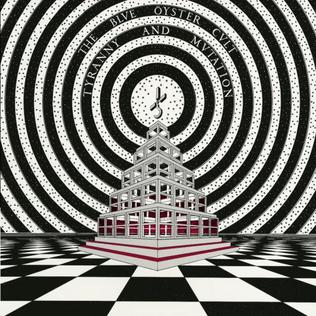
At the center is the symbol - hanging in space, half cross and half meat hook. Some claim it's made up of three exclamation points and an upside down question mark. Those with unfogged minds understand it to be the sign of Saturn, or Kronos, whose metal is lead and whose element is time itself.

In the grim days of Nixon and his carpet-bombing of Vietnam, while the Weather Underground waged its counter-bombing assault on America, during Apollo's last mysteriously abortive missions to the moon, this symbol was the closest a mainstream record label could come to putting a swastika on an album cover. To every teenaged Blue Oyster Cult fan, however, it was no secret. The sign stood unmistakably for outer space rock and roll fascismus.

The band's original name - "Soft White Underbelly" - was coined by Winston Churchill to describe fascist Italy, the vulnerable nether-region of Europe. It suggests too, the unprotected abdomen of the killer dinosaur, or the vastness of some trans-galactic egg-sac floating in the void. Conceived by their producer as America's answer to Black Sabbath, the renamed Blue Oyster Cult later joined forces with these English kings of downer rock on the infamous Black and Blue Tour.

The cover for Blue Oyster Cult's second album, Tyranny and Mutation, features a stark, geometrical black and white landscape like a Nuremberg rally site as conceived and birthed by robots. No humans, no torchlight parades, but the same emptiness and soulless fervor. And a weird celestial glow: the Kronos cross hanging on the horizon like a black, arcane sunrise. A few lurid slices are added to the palette for this album cover, finishing the scheme: black, white and red, the colors of Imperial Germany.

Musically, heavy metal already existed. It's all there on Black Sabbath's Paranoid album. But while Ozzie shrieks like a horror movie demon, the Oyster Boys use a more menacing, breathy whisper-croon. Ozzie's predicable satanic imagery and the lumbering behemoth riffs make a joke of Sabbath's dread-mongering. B-O'Cult are more oblique, more skewed and shrewd.

All gothic goes back to Germany and weird gothic touches lurk in these grooves - "flights of black horsemen" soaring over churches, "a harvest of life, a harvest of death." Even "Lucifer the light" makes an appearance. B-O'Cult is of course Germanic, with their mutant swastika, the very first heavy metal umlaut and hymns of praise to Luftwaffe jet planes. But this is still an American nightmare, not a faked-up olde worlde terror-fest. Yes, strange female presences float in the shadows. We'll never know, though, whether "Baby Ice Dog" is human or canine. Or what exactly the "Teen Archer" is aiming her arrows at. Or why is the "Mistress of the Salmon Salt" also called "The Quicklime Girl?"

On first hearing, "Hot Rails to Hell" might be just another badass heavy metal howl, proclaiming that "the heat from below can burn your eyes out." The world of this song is, however, no lapsed Euro-Catholic's Lake of Fire. The hellbound train is pure America - high tech, huge and heavy, enormous with energy, a smoking, steel-rumbling joyride that ends with a surf guitar bass plummet right out of the Ventures' "Pipeline."

Tyranny and Mutation: is there a better description of the American teenage boy's inner landscape? Tyranny: repression of impulse. Mutation: terrifying biological change. Tyranny and Mutation: are there two words which so well evoke the battle between wildness and control, the convulsive fear and joy at the heart of the adolescent's world?

Suzi Quatro


As the year’s primo slice of pseudo jailbait, Suzi Quatro broke big - sold millions of singles and was helpful in the self-polluting efforts of countless teenaged boys. She wasn’t an adolescent by the time this album came out, but Suzi was marketed as one - a strange mix of sleaze and juvenile vulnerability.

On the back of the album, she poses in a leather jump suit unzipped to her navel, with chains dangling on her bare chest. Hands on hips, staring back at teenaged fan-boys, she’s confident, sexy and young. On the front, she’s wearing a leather jacket and skin tight jeans. Her expression isn’t straight-up come-on. There’s a placid, almost lost, look in her eyes. She’s a pretty girl tarted up for her big career move, surrounded by her band: three shaggy reprobates. One is guzzling beer and sticking his hand down his pants. Another holds a cigarette and a beer and leers at the camera, as though to say, “yeah she’s barely legal and we’ve all done her.”

Suzi Quatro started out as a fifteen year old bass player in a band called The Pleasure Seekers. Going from sex to motherhood, that group evolved into Cradle. Mickey Most, like a music-biz pimp turning out his latest find, saw Suzi in ‘71 and moved her from her native Detroit to London. She had teenaged energy and good looks. But those aren’t that uncommon. The fact that she could really play bass set her apart, but her voice - something just one notch less annoying than a pantheress in heat - was exactly right for the moment. Her combination of androgynous feline yelping and soft-porn breathy whispers hit the record-buying mainline in ‘73. It’s sleaze all the way: “Glycerine Queen,” “Skin Tight Skin,” “Primitive Love,” “Shine My Machine,” and a very odd cross-gender rendition of “I Wanna Be Your Man.” The time was ripe for this kind of titillation. When a teenaged girl in black leather wails that she wants to be somebody’s man, it stirs troubling impulses in many hearts.

Maybe it was just a cheap commercial ploy - glam had broken big the year before, with plenty of rock musicians playing in the shallows of the turbid queer pond. And the hits here, “48 Crash” and “Can the Can” are basically catchy nonsense. There are some oblique bestiality references, but it certainly doesn’t add up to the battle cry for any sexual revolution. Suzi yelps about tigers and a “feline touch,” a boyfriend named Eagle, “evil lovin,’” and then repeats the inane rhymey chorus: “Put your man in the can, get him while you can.” Pushing her voice just beyond her range was supposed to evoke excitement, but Suzi sounds slightly hysterical here, like a cheerleader who’s taken a few too many snorts from her mom’s benzedrine inhaler before the big game.

The album contains an unsurprising mix of the sounds du jour: bluesy riffing, a little prog-rock keyboard noodling, a double-speed guitar solo. There are some T-Rex echoes. Slade and The Sweet too can be heard here, pop fodder teeny glitter. A whiff of rock and roll revival also floats off the disc (Suzi does “Shaking All Over” and “All Shook Up.”) It’s seldom noted, but the glam explosion was as much about the past as it was about the gender-bending gay-lib future. Shiny gold jackets, feathery boas, zoot-suit exaggeration - these come straight out of fifties-era show biz. Nobody ever topped Little Richard for outrageous gay wildness: gobs of makeup, huge hair, batting his eye-lids like neon butterflies. And he got there a whole generation before Bowie and Roxy and Jobriath.

Even the name Suzi Quatro seems to point to the past: “Suzi” from the Cheese-Whiz fifties and “Quatro” from the original Star Trek. So it should come as little surprise that she ended her career in the pseudo-50s nostalgia atrocity “Happy Days,” playing a tough crypto-slut named Leather Tuscadero.

Dark Side of the Moon


Of all the albums that entered our world in the year of ‘73, this is by far the most popular. Of all the discs in the entire history of recorded music, only one has sold more copies worldwide. There should be obvious reasons for such amazing success. But explanations - obvious or oblique - break down in this case.

Charisma? Hardly. Pink Floyd in ‘73 was the paragon of cold-blooded corporate rock - faceless, arrogant and isolated from the world. Devoid of stage presence or interesting life stories, the band consisted of four ordinary-looking men with boring names and no discernible talents that would set them apart from 10,000 other musicians. Virtuosic playing? Originality? Sex appeal? The visceral throb that gets people up and moving their bodies? Pink Floyd had none of these. Early on, when Syd Barrett was their front man, they were charmingly acid-addled, whimseyed and weird. Their “Interstellar Overdrive” sent their fans out through the gleaming stars. After Syd was gone, the band kept some of its cosmic sublime, but headed into more doom-laden terrain, “Set the Controls for the Heart of the Sun” being a perfect soundtrack for glorious teenage solar suicide. By ‘73, with Dark Side of the Moon and the hugely profitable tours around it, Pink Floyd had lumbered to the top of the dinosaur food chain, the reigning tyrant lizards of arena-rock. With upwards of 40 million units sold, with literally billions of plays, this music - like no other - flooded the earth with its message, the gospel of self-annihilation that the moon’s hidden side represents.

Golgotha is not just a place in the little Holy Land of the Middle East. The real Golgotha - “the place of the skull” - is in outer space, a quarter million miles away, orbiting around the earth. The moon is our primal, eternal skull-icon. And all of our skulls are tiny versions of the great skull in the sky. What do we see in the moon’s leering face? Eye holes, gaping toothless mouth, nostril slits, the empty stare of the Great Death’s-Head. Calvary is not just a place of ancient torture and obscure sacrifice. Calvary - “the place of the skull” - is out there, night after night. The moon is the universal face of death and also the earth’s primary mirror - shining back the light of the sun, the source of all life. So when this Face of Death stares raptly into itself, of course there is an invisible side of the reflection: the dark side, untouchable, unknowable, real and yet absolutely unseen.

As music, Dark Side of the Moon is a grand mediocrity. With its bloated blues imitations, fake soulful moaning, banal synthesizer squiggles, its utter absence of original melodies, lyrics, or musical hooks, this album should have disappeared into the great cut-out bin of LP oblivion. Instead, it sold in vast numbers and kept selling, spending a total of fifteen years in the charts. Ultimately, it colonized more brains than all of the albums released in ‘73 combined.

The secret of this record’s success is in fact no secret at all. It’s all right there in the title and the last line of the song “Brain Damage.” To the sullen, smug teenagers of the world (young and old) Roger Waters sings “I’ll see you on the dark side of the moon.” His lyrics mention racing “to an early grave,” exploding heads and brutal psycho-surgery. There may be many far better examples of I-want-to-die music. Originality, however, doesn’t sell. Complexity and intelligence don’t make for commercial world domination. The very banality of Dark Side of the Moon works in its favor. If a band is going to create a mass market hymn to self-obliteration, then subtlety is not going to be one of their tools. If Pink Floyd set out to make enormous profits, then playing directly to their audience’s inner deadness was exactly the right technique. Making self-pity into grandeur, numbness into stoned mysticism, stupidity into exaltation, Dark Side of the Moon is the perfect product. Heartless, pompous, blotting out everything like brain-death or an eclipse, whining and empty, this is the sound of cretinous nihilism, the wretched little self screaming “me! me! me!” in a vacuum.


On their previous - unnamed and unnamable - album, Led Zeppelin used four symbols to represent the four members of the band. The symbols all give the impression of secret truth hidden in plain sight. The first, Jimmy Page’s, sign is sometimes read as the magical nonsense word “Zoso.” For many fans this is the name of the fourth album. But the actual glyph itself is far more complex than a childish four letter word. It’s composed of four fused elements: a sleek and slithery Z with a curving tail, an elongated S that might also be a lost musical clef, two O’s with dots in the middle connected by a slender bar, and at the bottom a calligraphic scribble-slash that might be a pot-pipe or perhaps Aladdin’s lamp. All together, they form a sigil of power and bafflement. Nonsense perhaps, a magickal hippie doodle, or an arcana-scrawled doorway waiting to be opened.

Scholars, fan-boys, paranoid religiasts and esoteronauts have assigned a wide array of meanings to the glyph. Does it make reference to some Crowleyite spell? Is it an oblique Nietzschean strategy, the name “Zoroaster” compressed? Or split into the near-palindromes “Zoso” and “Rater”? Does this refer to Zoser, the Egyptian pyramid, or to herpes zoster, the viral pestilence? Benighted christians have seen “666” (the Mark of the Beast) in the emblem. We see the astrological sign for Saturn, the ringed planet, and the alchemical symbol for lead.

This emblem, well beyond the other three, had a life of its own, appearing on Jimmy Page’s amp, his shimmering cape, his silky wizard pants. But none of the symbols were to be seen on the fifth album. In effect, they had done their job - transforming themselves, from symbol to actual ritual. Houses of the Holy, Led Zeppelin’s next album, contains that ancient rite.

The cover shows the Giant’s Causeway: 37,000 hexagonal basalt columns on the north coast of Ireland. Some are complete, others broken. Some have sharp edges, like huge rusted nuts made to screw onto bolts. Others are like six-sided, lichen-crusted prehistorical wheels tipped on their sides. All of them fit together not as a puzzle but a temple built before mankind had ever come to that place. Dawn, or some baleful astral being, glows at the peak of the stones - sickly orange, crimson, seething yellow.

Opening the gatefold cover reveals a scene of pagan ritual. Is it sacrifice or exaltation? Eleven naked elf-children crawling over the stones, ascending - pale and ghostly - to meet their sunrise god. White-blond hair, powder-white skin. Not pasty subterranean pallor but soft forms dusty with sky-pollen.

They’re faceless, seen from behind. Six years old, maybe eight. Natural forms, not pure but prepubescent, like something Lewis Carroll would hallucinate on laudanum. Some claim they are all the same child, the body reproduced eleven times. But clearly some are boys and some are girls. Others say they are brother and sister, like a childish Siegmund and Sieglinde in The Valkyrie.

One lies on her belly like a mermaid. One squats. Another holds her hands above her head, in awe, expectation, opening herself to the solar crest-glow, making the same Y-shaped salute to the sun that the wandervogel and yogis used to greet and worship their god.

Inside the fold-out cover, a more overtly sacrificial image is revealed. It’s now sunset and a naked man holds a naked child above his head - clearly an offering - before the fungous nightmare ruins of Dunluce Castle. Rotted stumps of stone, a ravine crossed by a decrepit bridge, two towers, all decayed, all bathed in the same arcane radiation: oozy pink and orangey-green. Rich blue in the upper sky. It could be the surface of another planet, earth a million years in the future or the past.

It’s dusk now. The pale children are gone except the chosen one, the sacrificial offering. From the top of the citadel a faint white light gleams. And a milky beam extends downward to consume the naked priest and his offering.

New York Dolls


They’re the missing link, the evolutionary lost boys. Not a fossil or a dried-up dinosaur turd but a living, panting, gibbering pack of big city anthropoids, the New York Dolls carried the fool’s gold genes of glam rock and passed them on to the monkey horde of punks who followed close behind.

Glam rock, at first and second glance, was about nothing more than absurd clothes, gobs of makeup and alien aliases. Suburban kids dressed up as outer space drag queens, with feather boas, platform shoes and skintight silver pants. Scrawny white guys with boring names turned themselves into Ziggy Stardust, Eno, Gary Glitter, Jobriath, Johnny Thunders and Sylvain Sylvain. Glam is show-biz, and often is shrugged off as a fleeting shock wave from the gay-lib explosion, androgynous and pan-sexual youth gone wild on stage. And there’s no question that straight boys dressed as transsexual hookers are pushing (or at least slouching against) the walls of sexual order. There’s also the druggy halo to consider: heroin, cocaine, and speed were part of the seedy street-chic.

Still, there’s an unspoken, largely unseen element that looms here: something faintly gleaming in the corners of the mind like albino radiation sickness or nacreous moonglow. Glamor, we never forget, is in the oldest sense of the word about bewitchment. “Glamor” meant a magic spell or charm.

David Bowie sang about the “homo superior” in 1971 and about “making the wild mutation” a year later. Deodato put Nietzsche’s Uebermensch into heavy radio rotation. This isn’t progress we’re talking about, but transformation. This isn’t high tech shiny-future optimism, but real teratism - monster making. Mutants usually are highly unadaptive, often flat-out harmful to species survival. The New York Dolls got lost in the gene-jungle, pop culture natural selection making sure there were no direct offspring, no Darwinian success. They were five skinny white boys who mutated into nightmare Ken dolls - five versions of Barbie’s sexless mate dressed up as man-sluts and singing about their “Personality Crisis.” These Kabuki Kens, however, have real bulges in their pants. They’re anatomically correct and when the drugs allow, they’re ready to rut and shoot some bad seed.

Still, they’re both menacing and absurd, with their teased-up hair, gleaming lipstick, scarves, blotches of rouge and pubescent pouts. They never lost their confusion. Were they bad boys or sleazy fashion victims, sexual predators or kids playing dress-up? Later, they’d plumb the depths with too much junkie business, crashed careers, early death and the bass player converting to Mormonism. Always, though, they maintained their unapologetic stance: rude, crude, loud and wild.

There’s a “Lonely Planet Boy” and a “Jet Boy” on this album. Mostly, though, they stay in the street, bumping and grinding through “Bad Girl,” “Pills,” and “Trash.” Two largely overlooked songs point to something far more disturbing that drug-punk bad-assitude. Both are about tainted birth, the genesis of the Baleful Other. They’re not just sex songs, but confused, obsessive leaps into the pit of bio-reproduction.

After “me,” the word “baby” is probably the most common in rock and roll lyrics. In “Vietnamese Baby,” however, the Dolls are talking about about real conception and newborn spawn, the bastard offspring of a U.S. soldier and a nameless, faceless girl on the far side of the globe. The song starts and ends with a cliché Asian gong. In between there’s the standard proto-punk riffs and railing. As music, it’s okay. As a shout of confused dread (“talking ‘bout your overkill!”) it’s definitely not okay. We never know who’s the “you” of the song or why she’s got a Vietnamese baby on her “pretty little mind.” But we do understand that something is very wrong and it’s not going away.

The third Frankenstein song of ‘73 (labeled “original” on the album cover) was the last one of the year. Again we’re in movie-monster land - “shoes too big, jacket too tight.” And again Frankenstein stands for something ill-defined and intolerable. The song starts with an image of war, or biological disaster. “Something must’ve happened over Manhattan.” It quickly gets more personal, a repetitive, far-too-long track built mostly on unanswered questions. “Who could’ve spawned all the children this time?” We never find out. “Do you think you could make it with Frankenstein?” Is this about sex with a monster or is “make” here about literally making a baby, the nameless “it”?

1973 was the year of the American abortion. In January, Roe v. Wade transformed the country’s relationship with its unwanted offspring. Frankenstein’s creature calls himself an “abortion” and here on the Dolls’ first album he returns again: the divine portent of misfortune, the monster-spawn who may be loved, but who must be destroyed.