Sabbath Bloody Sabbath


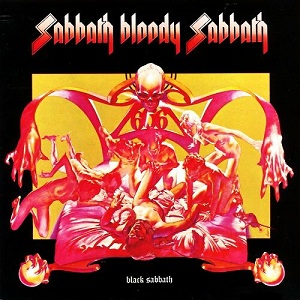
The egomaniac whine of the brain-sick teenager: no one conjured this sound better than Ozzy Osbourne. On the first four Black Sabbath albums, he screamed and wailed and did his horrific Hammer-films schtick. Still, like shouting “Boo!” in a crowded seance, the old spookshow was getting tiresome. The cover of the fifth album stays with the old satanic nightmare routine. But the music on the disc is more fit for high school vomit-buzz than human sacrifice.

1973 was the year the Romilar hit the fan. Sticky, nauseating, cheap, and available in every drugstore in America, Romilar cough syrup was the drug of choice for every self-disrespecting fifteen year old boy. Especially when drunk with loud pain-drenched metaloid music, dextromethorphan (the chief ingredient in Romilar) produces visual distortion, a messed up sense of time and space, sweats, diarrhea, dilated pupils, teeth-grinding and gut-spasms. Lo! dextromethorphan will take you there, to that wonderland of teenaged misery and madness.

By the end of ‘73, Romilar elixir had been pulled off the shelves and the brain-eating puke-euphoria tidal wave was over. So Black Sabbath’s gift for Christmas of ‘73 was perfect, like cough syrup converted into sound. Ozzy gives us a few of the usual references to hell and damnation. Still, there’s less focus on the fate of his immortal soul than on his gag reflex and the swollen tissue of his brain. With the headphones clamped on tight and the volume knob turned far into the skull-crushing zone, this album is the aural equivalent of three bottle of Romilar.

Sabbath’s earlier albums had all sold millions and the band’s wealth got them all the best liquor and drugs they wanted. While they might’ve been rehearsing with their noses burnt by high grade coke and their guts sloshing with cognac and twelve year old scotch, they continued to make music not for millionaires, but kids working at minimum wage.

The band, dulled by drugs and success, had started rehearsals in L.A. This fell apart and they ended up renting Clearwell Castle in the ancient royal forest of Dean. Guitarist Tony Iommi claimed that the fifth album really came alive in the dungeons there. Supposedly the riff for the album’s title track was born in the gloom and grue of medieval torture chambers. But like the mock-demonic doom rides of the earlier albums, this too is mostly booga-booga cooked up for gullible American kids. Even the castle itself was a fake - though looking medieval, it was built in the 1700s as a retro-nostalgia folly.

Cut away all the gothick claptrap and what’s left is primo vintage-73 pukadelic product. Here, the kings of downer metal serve up their last great heap of steamy sound-stench. They give a halfhearted nod to the prog rock of the day: there are a few synthesizer squigglies courtesy of Rick Wakeman, on loan from Yes. Iommi does an acoustic guitar noodle track, named “Fluff” for obvious reasons. The rest, the tunes that teenagers kept lifting the needle to replay, are swollen Romilar-riffs with Ozzy’s razor blade pain-shriek on top.

Not surprisingly, he adds plenty of death-yammer: “no return . . . killing yourself . . . into the dust . . . dying day . . . living death . . . execution . . . living just for dying . . .” What fifteen year old locked in his bedroom in a dextromethorphan daze wouldn’t think this is the most profound poetry he’d ever heard?

“Pain, suffering and misery!” Ozzy wails. “You bastards!” he screams. Iommi keeps grinding out the hallucinogenic buzz-sludge. Ozzy keeps shrieking about “universal secrets” and “the secret within your mind.” And fifty thousand sublimely unhappy teenagers retch into paper bags.


Jumpin' the Gunne


Jumpin’ the Gunne


I really want to hate this thing. I want to claim that it’s the worst of the worst. 1973 gave us so much that was so wrong. Hyperbolic bombast - Brain Salad Surgery. Early senility rock - Goat’s Head Soup. Opiated suicidal sump-diver sludge - Lou Reed’s Berlin. And Uriah Heep Live. Against such festering slabs of musical offal, how could a one-hit wonder band achieve such singular status?

JoJo Gunne were not incompetent. That might have provided some amusement, like watching a drunken toddler drive an ambulance full of burn victims. The band was in fact cursed by competence. They can make a passable boozed-up yahoo boogie sound with pseudo-funky slide guitar and LA-rock piano stylings.

What makes Jumpin the Gunne so bafflingly awful is the balance it strikes between minimal ability and drug-addled idiocy. I think this album contains third-rate white boy shoogity-boogity, but I’m not sure. I want to claim it’s the worst, but I don’t think I’ll ever truly know. With song titles such as “Monkey Music” and “High School Drool,” it promises something that will at least be offensive. No such luck. My ear drums register the sound, but a nanosecond later, nothing remains.

No matter how I approach it - headphones in a dark room or as party-noise - I literally can’t listen to this album. I don’t mean I run screaming to yank it off the turntable. I mean my brain truly cannot process the sound. JoJo Gunne manages the amazing feat of creating something so profoundly mediocre that almost nothing sticks in my mind.

Then I gaze at the cover and my hopes rise again. Jumpin’ the Gunne should be truly horrible. Some coke-headed cretin decided that showing a hugely obese buck-naked chick magically flying out of bed (where the four Gunne boy are sitting under the covers) would make for solid sales. Better (or worse) yet is the inside of the fold-out sleeve, where again Ms. Corpulence is displayed, on her belly, making kissy faces to a small happy piglet.

All the album credits are written on her naked pink flesh - including the requisite “Made to be played loud” claim and the mysterious acknowledgment “Cowboy pig courtesy Warren Archer.”

The band ‘s only real hit - “Run Run Run” - was the first single I ever bought. It’s tuneful, rollicking and still tickles the tiny bones in my middle ear. But that’s all. Beyond “Run Run Run” JoJo Gunne’s legacy is just vapor and haze, a ghost that floats in the interzone reaches of popcult nowhereland.

Best? Worst? They’re meaningless words. Aesthetic terms are like bits of crusty burnt food and this album is coated with Super-Teflon. It’s beyond, above, outside any categories of judgment. I’m not even positive that the thing actually exists. I can hold the cover in my hands and put the disc on the turntable. I can gaze at the flying porcine bimbo with the inexplicable white ankle-strap platform shoes. I can try to listen and remember, but it’s like light passing through clear glass, or gamma rays passing through my body: no trace is left behind.


ROCK ON


Here is the ghost in the Top 40 machine, a spectral cry to raise the dead. Here is the gleaming slice of occult vinyl that goes where no song has gone before, and comes back with the prettiest corpse in Hollywood history. Hear the exhortation to some nameless “kid” - and understand why there is a legend that the track was actually cut in James Dean’s tomb.

Pulsing from a million radios in the holy year of 73, David Essex’s “Rock On” is a fulcrum balancing both past and future, one of the crucial songs of this most crucial of years. Echoing in a haze of Jamaican dub (with reverb-soaked bass playing lead, tom-toms and congas giving a jungle vibe, dead stops opening into absolute harrowing silence, and no guitar) it anticipates music that will be supposedly cutting edge ten years later. “Rock On” also harks back to 50s-era poppy dreamland, conjuring up summertime blues and blue suede shoes.

It’s obvious, though, that more than nostalgia animates the singer. This compulsive call to “Rock On” rises years before cretin-metal devil horn handjiving. It doesn’t mean merely to get stupid and loud. This “Rock On” points toward ghosty resurrection. The question “Where do we go from here?” comes from nowhere and finds no answer. Sadness and death linger in the grooves. Multi-tracked vocals add to the opioid reverie. “See her shake on the movie screen.” Who is the “Baby Queen”? We never find out.

The hypnotic bass on “Rock On” is played by the great Herbie Flowers. Creating the brilliant throb-bottoms for 1972’s “Jump Into the Fire” and “Walk On the Wild Side,” anchoring Bowie’s Diamond Dogs album and hundreds of other hits, Herbie Flowers was the primo bass presence of the era.

Disco too lurks in the grooves. The strings on early-70s dance-hits are universally despised by critics and ignored by dance-floor fans. But the pocket-orchestra riffing is exactly what lifts disco from its banality. Disco’s beat is moronically monotonous, and the lyrics idiotic (“boogie oogie oogie” indeed). However, the sleaze of studio strings and quasi-jazz horn intrusions are exactly what brings the devotee back again and again.

As a one-hit wonder who ended up far more successful acting than making music, David Essex here does the cinematic mind-meld. The song veers toward romance (“prettiest girl I ever seen”), then fades into a lost-soul call: hissing slippery sibilants (“sssssssh”) and gospel wails (“oh my soul!”). More trance than dance, more necromantic spell than pop song, “Rock On” still lingers in the ether - tugging at the souls of dead stars and lonely planet kids who remember, or who have convinced themselves that their music-spawned memories are real.

BIG GURL - Maximum Fun Assault


She's back - after 23 years in the shadows. Huge, sexy, a juggernaut of stunning idiocy and murder-glee genius, Big Gurl has returned to conquer all electronic reading devices and human brains. For exactly the same price as the original paperback edition, this underground classic is now available to any who dare enter its turgid and tainted depths.

"Big Gurl is the prose equivalent of R. Crumb and S. Clay Wilson stoned on evil speed and Sterno." - Hakim Bey

tinyurl.com/biggurlbeats

The Plan


Glam rock had two crypto-Mormons: Mick Ronson and Arthur Killer Kane. The Osmond Brothers on the other hand were up front about their religio-sexual orientation. Five squeaky-teen heartthrob guys with gleaming teeth and big hair, they released their Plan in the middle of glam's greatest year.

White and shiny as mayonnaise, the Osmonds had been dominating the charts since 1970. After a run of massively successful albums, though, they wanted to stretch out and to tell the Latter Day Saint story through song. So they retired to their private musical sanctum (Kolob Studies in Los Angeles - named after God's home-planet) and came up with this Great Hetero Mormon Mini-opera Concept Album.

There's a lot less bubble-gum here than on their earlier records, which explains why it did so poorly with the fans. Not many twelve year old non-LDS girls with the hots for Donny wanted to hear about pre-mortal existence and the end of the world.

As a concept album, it starts predictably with the jingle of Asian bells, ancient flutes, mysterioso harp plinking and voices floating from channel to channel. Mostly though, the album is slick radio-friendly pop with a few nods toward glam.

God's mysterious plan keeps coming up, though it's never made explicit. Heaven gets mentioned. Heavenly Father and the Mormon prophet Joe Smith remain in the shadows, or are far above, orbiting around earth. Like Bowie's Aladdin Sane and Jobriath himself, the singer on "Goin' Home" is a "space man from a different land" and he needs to return.

The first track is "War in Heaven" and at the end we learn about "The Last Days." Even in the sappiest love song on the album, "Darlin,'" the Osmonds manage to slide in some LDS theology. Like other songs on this revelation-drenched slab of vinyl, "Darlin'" mixes up romance and revelation. "There's no end if I'm with you," the boys sing with their hormone-hyped voices. Clearly, they're excited about something. But what? True love? True religion? "Let Me In" is the most disturbing track. Twisting together spirituality and sleazy seduction, it's one of the best God-is-my-girlfriend songs ever recorded.

Some songs are so oblique that even Mormon initiates can't pierce their glistening surface. Featuring a funky Jew's harp and squealy harmonica, "Mirror, Mirror" condemns some nameless other-self who'll "step on those who kiss your feet," and ends with the warning "you can't fool me."

For those in the know, the line "as we would be, he once was" is straight out of Mormon theology. If we just accept the teachings of the whitest religion in the world, we all can become gods and have our own planet, as gloriously snazzy as Kolob. There's real endless power waiting for the Mormon faithful. When the Osmonds sing "we control infinity" they mean it as literal truth.


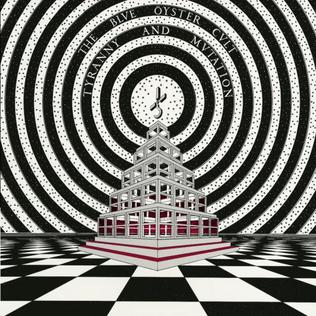
At the center is the symbol - hanging in space, half cross and half meat hook. Some claim it's made up of three exclamation points and an upside down question mark. Those with unfogged minds understand it to be the sign of Saturn, or Kronos, whose metal is lead and whose element is time itself.

In the grim days of Nixon and his carpet-bombing of Vietnam, while the Weather Underground waged its counter-bombing assault on America, during Apollo's last mysteriously abortive missions to the moon, this symbol was the closest a mainstream record label could come to putting a swastika on an album cover. To every teenaged Blue Oyster Cult fan, however, it was no secret. The sign stood unmistakably for outer space rock and roll fascismus.

The band's original name - "Soft White Underbelly" - was coined by Winston Churchill to describe fascist Italy, the vulnerable nether-region of Europe. It suggests too, the unprotected abdomen of the killer dinosaur, or the vastness of some trans-galactic egg-sac floating in the void. Conceived by their producer as America's answer to Black Sabbath, the renamed Blue Oyster Cult later joined forces with these English kings of downer rock on the infamous Black and Blue Tour.

The cover for Blue Oyster Cult's second album, Tyranny and Mutation, features a stark, geometrical black and white landscape like a Nuremberg rally site as conceived and birthed by robots. No humans, no torchlight parades, but the same emptiness and soulless fervor. And a weird celestial glow: the Kronos cross hanging on the horizon like a black, arcane sunrise. A few lurid slices are added to the palette for this album cover, finishing the scheme: black, white and red, the colors of Imperial Germany.

Musically, heavy metal already existed. It's all there on Black Sabbath's Paranoid album. But while Ozzie shrieks like a horror movie demon, the Oyster Boys use a more menacing, breathy whisper-croon. Ozzie's predicable satanic imagery and the lumbering behemoth riffs make a joke of Sabbath's dread-mongering. B-O'Cult are more oblique, more skewed and shrewd.

All gothic goes back to Germany and weird gothic touches lurk in these grooves - "flights of black horsemen" soaring over churches, "a harvest of life, a harvest of death." Even "Lucifer the light" makes an appearance. B-O'Cult is of course Germanic, with their mutant swastika, the very first heavy metal umlaut and hymns of praise to Luftwaffe jet planes. But this is still an American nightmare, not a faked-up olde worlde terror-fest. Yes, strange female presences float in the shadows. We'll never know, though, whether "Baby Ice Dog" is human or canine. Or what exactly the "Teen Archer" is aiming her arrows at. Or why is the "Mistress of the Salmon Salt" also called "The Quicklime Girl?"

On first hearing, "Hot Rails to Hell" might be just another badass heavy metal howl, proclaiming that "the heat from below can burn your eyes out." The world of this song is, however, no lapsed Euro-Catholic's Lake of Fire. The hellbound train is pure America - high tech, huge and heavy, enormous with energy, a smoking, steel-rumbling joyride that ends with a surf guitar bass plummet right out of the Ventures' "Pipeline."

Tyranny and Mutation: is there a better description of the American teenage boy's inner landscape? Tyranny: repression of impulse. Mutation: terrifying biological change. Tyranny and Mutation: are there two words which so well evoke the battle between wildness and control, the convulsive fear and joy at the heart of the adolescent's world?

Suzi Quatro


As the year’s primo slice of pseudo jailbait, Suzi Quatro broke big - sold millions of singles and was helpful in the self-polluting efforts of countless teenaged boys. She wasn’t an adolescent by the time this album came out, but Suzi was marketed as one - a strange mix of sleaze and juvenile vulnerability.

On the back of the album, she poses in a leather jump suit unzipped to her navel, with chains dangling on her bare chest. Hands on hips, staring back at teenaged fan-boys, she’s confident, sexy and young. On the front, she’s wearing a leather jacket and skin tight jeans. Her expression isn’t straight-up come-on. There’s a placid, almost lost, look in her eyes. She’s a pretty girl tarted up for her big career move, surrounded by her band: three shaggy reprobates. One is guzzling beer and sticking his hand down his pants. Another holds a cigarette and a beer and leers at the camera, as though to say, “yeah she’s barely legal and we’ve all done her.”

Suzi Quatro started out as a fifteen year old bass player in a band called The Pleasure Seekers. Going from sex to motherhood, that group evolved into Cradle. Mickey Most, like a music-biz pimp turning out his latest find, saw Suzi in ‘71 and moved her from her native Detroit to London. She had teenaged energy and good looks. But those aren’t that uncommon. The fact that she could really play bass set her apart, but her voice - something just one notch less annoying than a pantheress in heat - was exactly right for the moment. Her combination of androgynous feline yelping and soft-porn breathy whispers hit the record-buying mainline in ‘73. It’s sleaze all the way: “Glycerine Queen,” “Skin Tight Skin,” “Primitive Love,” “Shine My Machine,” and a very odd cross-gender rendition of “I Wanna Be Your Man.” The time was ripe for this kind of titillation. When a teenaged girl in black leather wails that she wants to be somebody’s man, it stirs troubling impulses in many hearts.

Maybe it was just a cheap commercial ploy - glam had broken big the year before, with plenty of rock musicians playing in the shallows of the turbid queer pond. And the hits here, “48 Crash” and “Can the Can” are basically catchy nonsense. There are some oblique bestiality references, but it certainly doesn’t add up to the battle cry for any sexual revolution. Suzi yelps about tigers and a “feline touch,” a boyfriend named Eagle, “evil lovin,’” and then repeats the inane rhymey chorus: “Put your man in the can, get him while you can.” Pushing her voice just beyond her range was supposed to evoke excitement, but Suzi sounds slightly hysterical here, like a cheerleader who’s taken a few too many snorts from her mom’s benzedrine inhaler before the big game.

The album contains an unsurprising mix of the sounds du jour: bluesy riffing, a little prog-rock keyboard noodling, a double-speed guitar solo. There are some T-Rex echoes. Slade and The Sweet too can be heard here, pop fodder teeny glitter. A whiff of rock and roll revival also floats off the disc (Suzi does “Shaking All Over” and “All Shook Up.”) It’s seldom noted, but the glam explosion was as much about the past as it was about the gender-bending gay-lib future. Shiny gold jackets, feathery boas, zoot-suit exaggeration - these come straight out of fifties-era show biz. Nobody ever topped Little Richard for outrageous gay wildness: gobs of makeup, huge hair, batting his eye-lids like neon butterflies. And he got there a whole generation before Bowie and Roxy and Jobriath.

Even the name Suzi Quatro seems to point to the past: “Suzi” from the Cheese-Whiz fifties and “Quatro” from the original Star Trek. So it should come as little surprise that she ended her career in the pseudo-50s nostalgia atrocity “Happy Days,” playing a tough crypto-slut named Leather Tuscadero.